THE SHABBOS EFFECT AS A (DDD) “DIVINE DIGITAL DETOX” Torah, Neuroscience, and a Taste of the World to Come

In an age of endless scrolling, fractured attention, and the quiet tyranny of constant availability, the idea of a “digital detox” has become a modern necessity. Yet long before we had language for dopamine loops, attentional fatigue, and cognitive overload, Torah had already established a recurring “sanctuary in time.”
Shabbos may be understood as an act of Divine foresight. The Creator – Whose ineffable name says that He, “Who Was, Is, and Will Be as One” – embedded into the structure of time a protected interval in which we step back from production, manipulation, and, in our era, the hypnotic pull of digital immersion. What can appear to be an ancient and antiquated day of rest reveals itself as a remarkably precise antidote to a distinctly modern dis-ease. This dis-ease is not necessarily pathology. It is, quite literally, a loss of ease.
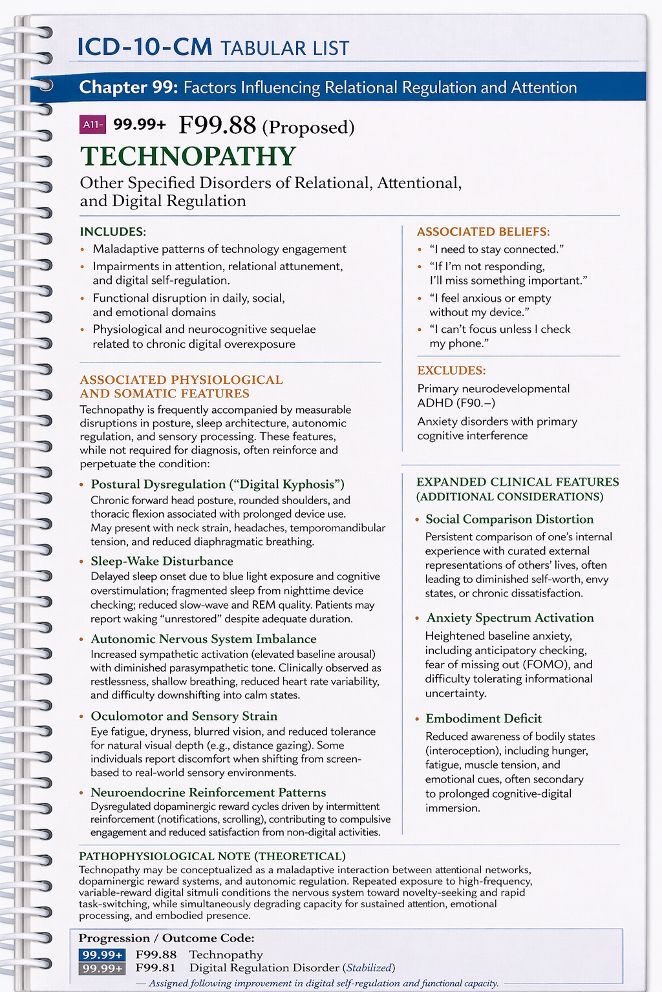
Digital life trains the nervous system toward perpetual activation. Notifications function as intermittent rewards, drawing the brain into cycles of anticipation rather than fulfillment. Attention becomes fragmented, the prefrontal cortex repeatedly interrupted, and the ability to dwell deeply on anything begins to erode. Over time, continuous engagement can also affect stress levels, sleep, and the body’s capacity to settle into restoration. We grow accustomed to low-grade vigilance and forget what genuine rest feels like. I call this, “Technopathy” (If one were to imagine this phenomenon formally classified, it might read something like my mock ICD-10 diagnosis )
Against this background, Shabbos appears not only as a mitzvah, but as mercy.
The Torah describes the first Shabbos as both cessation and sanctification: “Vayishbos…Vayikadeish” – And He rested… and He sanctified” (Bereishis 2:2–3). Chazal call it me’ein Olam Haba – a foretaste of the world to come (Berachos 57b). Shabbos is therefore not merely a pause from labor; it is a weekly return to a more whole and properly ordered mode of being.
From a neuroscientific standpoint, this cessation is deeply regulatory. Removing the barrage of digital input interrupts reward-seeking loops and reduces the micro-activations of stress that keep the nervous system on edge. In simple terms, the brain begins to remember how to settle. But Shabbos is not only an emptying. It is a filling. Davening offers structured attentional training. Unlike digitally captured attention, prayer directs awareness intentionally through rhythm, repetition, melody, and meaning. Rather than scattering the self, it gathers it. In Torah language, this reflects the concept of MeLeCh—moach, lev, kaveid—mind, heart, and drives—an inner hierarchy in which the mind gently governs emotional and instinctual life.
Even the walk to synagogue matters. In a compressed and sedentary digital culture, walking restores rhythm, embodiment, and presence. Unaccompanied by devices, it becomes more than transportation; it becomes regulation. Sometimes the simple act of walking—breathing, singing softly, moving at a human pace—quietly recalibrates the soul.
Community further deepens the “Shabbos effect.” Face-to-face conversation, communal singing, shared meals, and unhurried presence counter the thin simulations of connection so often offered by screens. At a lively kiddush or a quiet Shabbos table, one encounters something increasingly rare: human beings fully with one another.
And when Shabbos is quieter, reading and Torah learning take center stage. Deep reading restores capacities that digital skimming weakens: attention, imagination, memory, and empathy. Torah learning adds yet another dimension. As Pirkei Avos teaches, “Turn it and turn it, for everything is in it.” This is the opposite of novelty-chasing. It is an apprenticeship in depth.
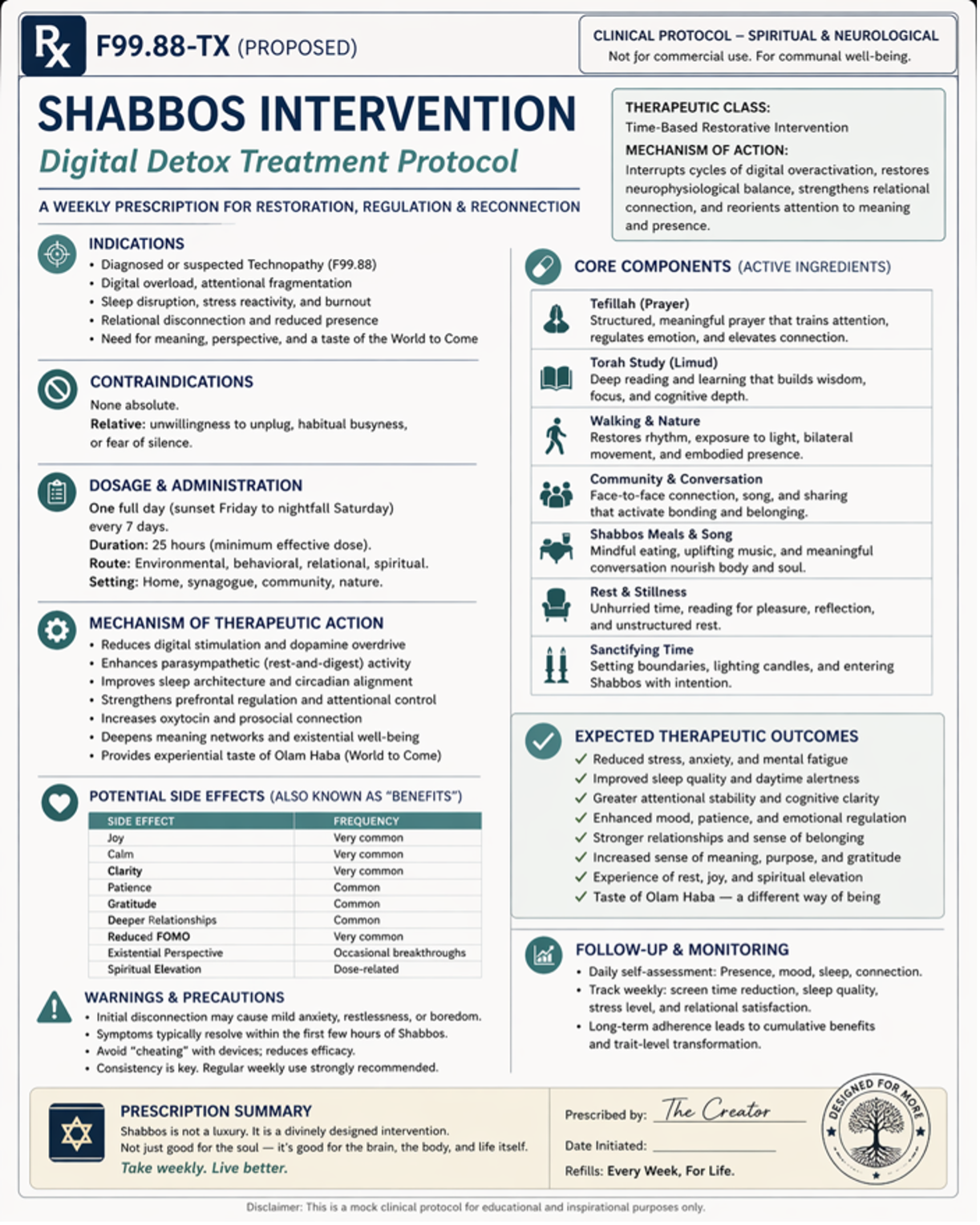
Each of these elements counters a weekday imbalance. Fragmentation is met with continuity. Hyperstimulation is met with gentle pleasure. Performative connection is replaced by genuine presence. Information overload yields to wisdom. Compulsion yields to choice. With a bit of whimsy, I’ve created this Shabbos Intervention Digital Detox Tx Protocol. (Disclaimer: For educational and inspirational purposes only)
Importantly, Shabbos does not reject the world; it reorders it. The problem is not technology itself, but inverted hierarchy—when the machine governs the human rather than the human directing the machine. Shabbos trains that hierarchy each week. It teaches that a person can step away, live without constant input, and reconnect to essence.
Chazal’s description of Shabbos as ‘a taste of the world to come’ resonates across every domain. Spiritually, it offers holiness. Psychologically, coherence. Neurologically, regulation. Existentially, a glimpse of life rightly aligned toward peace.
Each week, Shabbos gathers the scattered pieces of the person and returns the mind to depth, the nervous system to calm, and the soul to its source. It reminds us that wholeness is not something we must invent someday. It is already given—one day at a time, one week at a time.
Read a more in-depth SUBSTACK article HERE
With Gratitude,
Rus Devorah