
FROM COLD CONTRAST TO COCOON… and Why Integration Cannot Be Rushed
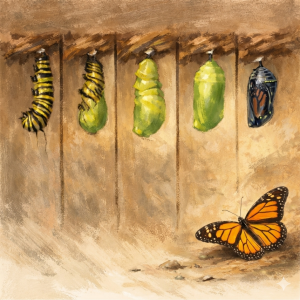
The other day, after a cold contrast shower, I chose not to warm up in the usual way. I did not stay under hot water, nor did I rush into getting dressed and returning to productivity. Instead, I slipped directly into my pre-heated infrared heating bag and let the warmth return slowly. What I felt was more than comfort. It felt like re-entry, like being held, like a cocoon.
That image stayed with me because it captured something essential about transformation. A caterpillar in its chrysalis looks inert from the outside, almost stagnant. But biologically, it is undergoing radical reorganization. Its old structures dissolve: new ones emerge. Wings, sensory organs, and an entirely different body plan are formed inside a protective container. This stage is not a pause in development. It is the developmental crucible itself. And if the chrysalis is opened too early, the butterfly cannot survive. Timing is not incidental. Timing is the mechanism. We must not Rush the Cocoon! That truth flowed naturally into how I understand in-depth psychotherapy. Therapy is not simply advice, psychoeducation, or problem-solving, however valuable those may be. At its essence, therapy is a protected relational container: a steady, bounded, consistent space in which a person can reorganize emotionally, cognitively, somatically, and relationally. The therapeutic relationship itself becomes the cocoon.
This is why I often call therapy, “Dress Rehearsal for Life.” Week after week, the therapist shows up, usually for 50 minutes, offering sustained and nonjudgmental presence. Over time, that consistency allows thoughts, feelings, bodily states, and relational patterns to emerge and be metabolized rather than suppressed, bypassed, or managed away. The relationship is not merely the backdrop for the work. It is the work. Many clients understandably want to “get things done.” They want progress, relief, insight, movement. But process and integration are not luxuries. They are the means through which real change becomes possible. Through regular sessions, and through the inevitable ruptures and repairs that occur in any real relationship, therapy gradually becomes a place where a person can feel held, contained, and supported enough for deep reorganization to occur.
This understanding is not only poetic; it is clinically grounded. Across therapeutic modalities, the quality of the therapeutic alliance remains one of the strongest predictors of outcome. Attachment theory helps explain why: repeated experiences of responsiveness reshape expectations about closeness and trust. Neurobiologically, the therapist becomes a co-regulating presence, helping the nervous system move from threat toward safety. Memory reconsolidation research deepens this further. For old emotional learning to change at its roots, it must be activated and then paired with a new, incompatible experience: steadiness instead of abandonment, curiosity instead of judgment, presence instead of dismissal. This cannot be rushed. Integration requires containment.
As I lay warming after the cold, a Torah teaching came to mind that illuminated the whole metaphor. In a well-known teaching associated with the Rebbe Rashab, chassidim sang the preparatory niggun before a ma’amar too quickly, eager to get to the main event. The Rashab objected strongly. His point was profound: preparation is not a disposable prelude. When one is engaged in preparation, one must be fully present in it. The avodah must be done b’shelimus — with wholeness. Being on the way to something greater does not excuse partial engagement.
Psychology and Torah meet here. The internal state with which one enters determines what can be received. Rushing collapses the vessel. As Chazal teach: tafasta meruba lo tafasta — when one grasps for too much, one holds nothing. But tafasta mu’at tafasta — when one takes what is containable, something real can be held. The same is true in therapy, in spiritual life, and even in hormesis. The cold may initiate the challenge, but the quality of the return to warmth completes the experience. The benefit lies not only in activation, but in the re-entry into safety. The chrysalis cannot be forced open. The preparatory niggun cannot be rushed. The therapeutic relationship must be given time to grow. What appears to be stillness is often the most active phase of change. Integration is quiet. Transformation is slow. And the conditions that make healing possible are not separate from the work. They are the work itself.
Read a more in-depth SUBSTACK article HERE
With Gratitude,
Rus Devorah