
Learning To Stay – Object Relations, Safety, And Slowing Down

Rus Devorah (Darcy) Wallen, LCSW, ACSW, CIMHP
This semester, I’m teaching courses in psychodynamic psychotherapy and social work ethics—subjects centered on safety, boundaries, and relational presence. At the same time, I find myself on the other side of the chair, deeply immersed as a client in the very kind of therapeutic relationship I’ve spent decades trying to offer others. That convergence feels meaningful, humbling, and unexpectedly transformative.
For the past year, I’ve been working with a therapist who embodies the values we teach but rarely get to experience so fully: steadiness, reliability, clear boundaries, and deep respect for another’s inner life. She doesn’t just practice these principles—she lives them. In her presence, I’m finally inhabiting what we call a “holding environment,” not as theory, but as lived experience. After a lifetime of being the provider of safety, I’m learning how it feels to receive it.
To understand why this matters so much, I need to begin with my early relational world. I had loving, supportive parents. There was no overt trauma or neglect. And yet, my mother—brilliant, capable, deeply engaged in her community—was most available during moments of significance: achievements, crises, milestones. Ordinary, everyday connection was less reliably accessible. I didn’t experience this as rejection. I experienced it as information.
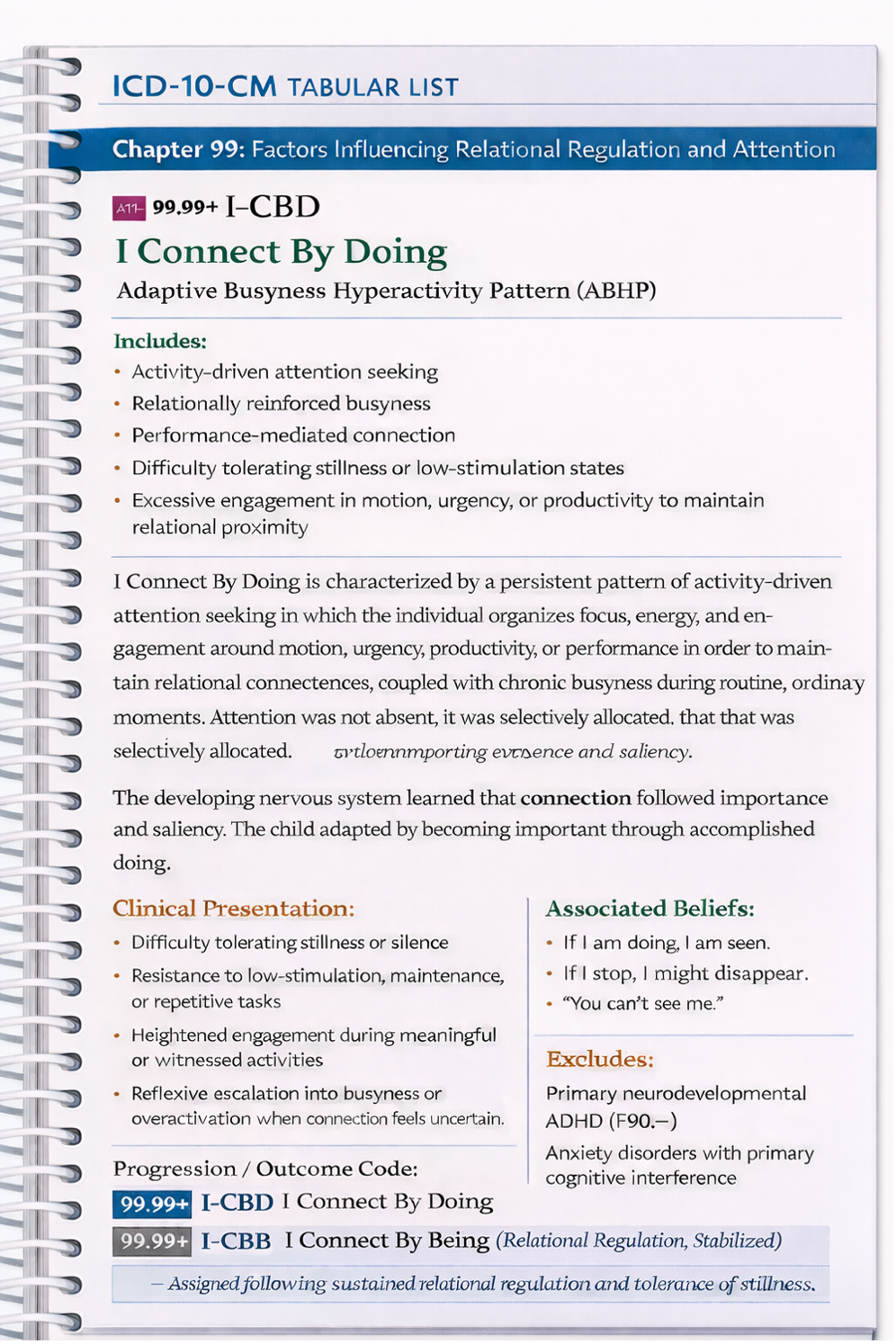
Over time, I learned a quiet relational rule: significance brings connection; ordinariness does not. So, I adapted. I became busy, accomplished, productive. I learned to connect by doing—by achieving, performing, contributing, and giving. I jokingly call this adaptation “I-CBD”: I Connected By Doing. A mock ICD-10 diagnosis. It worked. I became effective, engaged, and successful. I didn’t become needy; I became competent.
But what my nervous system needed was never more attention—it was more consistent attention. Not intensity, but reliability.
This pattern followed me into the therapy room. I filled space quickly, talked fast, managed momentum. What I’m learning now is that what regulates me most is not unlimited access, but predictable availability within a clearly held frame. Knowing I have one protected, uninterrupted fifty-minute hour each week—consistently and reliably—is profoundly settling. Even if everything isn’t processed. Even if every excitement isn’t mirrored. The container itself does the work.
As safety settles, something shifts. I feel less compelled to fill silence or hold the relationship up through effort. I’m learning to trust the vessel rather than prop it up. In that slowing, I can finally receive my therapist’s wisdom—not because it wasn’t there before, but because my system is quiet enough to take it in.
My body has been teaching me this lesson for years. Nearly nine years ago, I experienced what I now call “my stroke of good fortune.” It forced me to stop when I couldn’t stop myself. That first slowing was imposed—necessary, frightening, and lifesaving. I listened because I had to.
ENJOY MY SUNO SONG – I WANNA THANK YOU FOR THIS LOVIN’ LIFE – Men’s AI Vocals
What’s happening now is different. This slowing is chosen.
I notice it in small ways: tolerating pauses, interrupting less, catching impulsivity mid-flight. I move more carefully, sleep more deeply, savor my food, feel fewer warning signals in my body. This is regulation—not imposed, but internalized.
In Torah terms, it feels like the difference between the first and second giving of the Torah. The first was overwhelming; the second was quiet, chosen, integrated. The teaching didn’t change. The vessel did.
This is the transition I’m living now: from I Connected By Doing to I Connect By Being. The stroke taught me how to stop running. This gentler phase is teaching me how to stay.
“I have learned to calm and quiet my soul,” the psalmist writes, “like a weaned child with its mother.” Not because I was forced—but because I’ve learned I am safe enough to settle.
This feels like the deepest kind of healing: choosing limits rather than obeying them, inhabiting connection rather than managing it. Not a hard stop, but a gentle stroke. A caress. A glett on the cheek.
And little by little, I am learning.
Read a more in-depth SUBSTACK article HERE
We love hearing from you, please feel free to leave your comments below.
With Gratitude,
Rus Devorah
Selected References
Ainsworth, M. D. S., Blehar, M. C., Waters, E., & Wall, S. (1978). Patterns of attachment.
Bion, W. R. (1962). Learning from experience.
Bowlby, J. (1969). Attachment and loss, Vol. 1.
Fairbairn, W. R. D. (1952). Psychoanalytic studies of the personality.
Fonagy, P., Gergely, G., Jurist, E., & Target, M. (2002). Affect regulation and the development of the self.
Kohut, H. (1971). The analysis of the self.
Ogden, T. H. (1994). The analytic third. Int’l Journal of Psychoanalysis, 75, 3–19.
Schore, A. N. (1994). Affect regulation and the origin of the self.
Siegel, D. J. (2012). The developing mind (2nd ed.).
Winnicott, D. W. (1958). The capacity to be alone. Int’l Journal of Psychoanalysis, 39, 416–420.
Winnicott, D. W. (1960). Parent–infant relationship. Int’l Journal of Psychoanalysis, 41, 585–595.
Torah Sources
Shemot 19–20; 32–34
Devarim 5
Shabbat 88a–b
Yoma 86a
Megillah 7a
Shir HaShirim Rabbah 5:6
Tehillim 131:2